Intranet: Reimagined
From reactive support to strategic partnership

Overview
The Intranet: Reimagined initiative transformed Workday’s fragmented internal knowledge ecosystem into a unified, insight-driven platform serving Customer Success, Education, and Product teams globally.
As Lead Product Designer, I guided the vision, experience architecture, and cross-functional delivery that turned disconnected portals into a cohesive digital workspace. The result was faster access to knowledge, measurable efficiency gains, and a design governance model that continues to shape how Workday collaborates at scale.
Challenge: The Problem of Organizational Friction
| "A fragmented intranet became a catalyst for unity and purpose."
The corporate intranet had long been the subject of company-wide frustration. It represented a classic case of deep design debt.
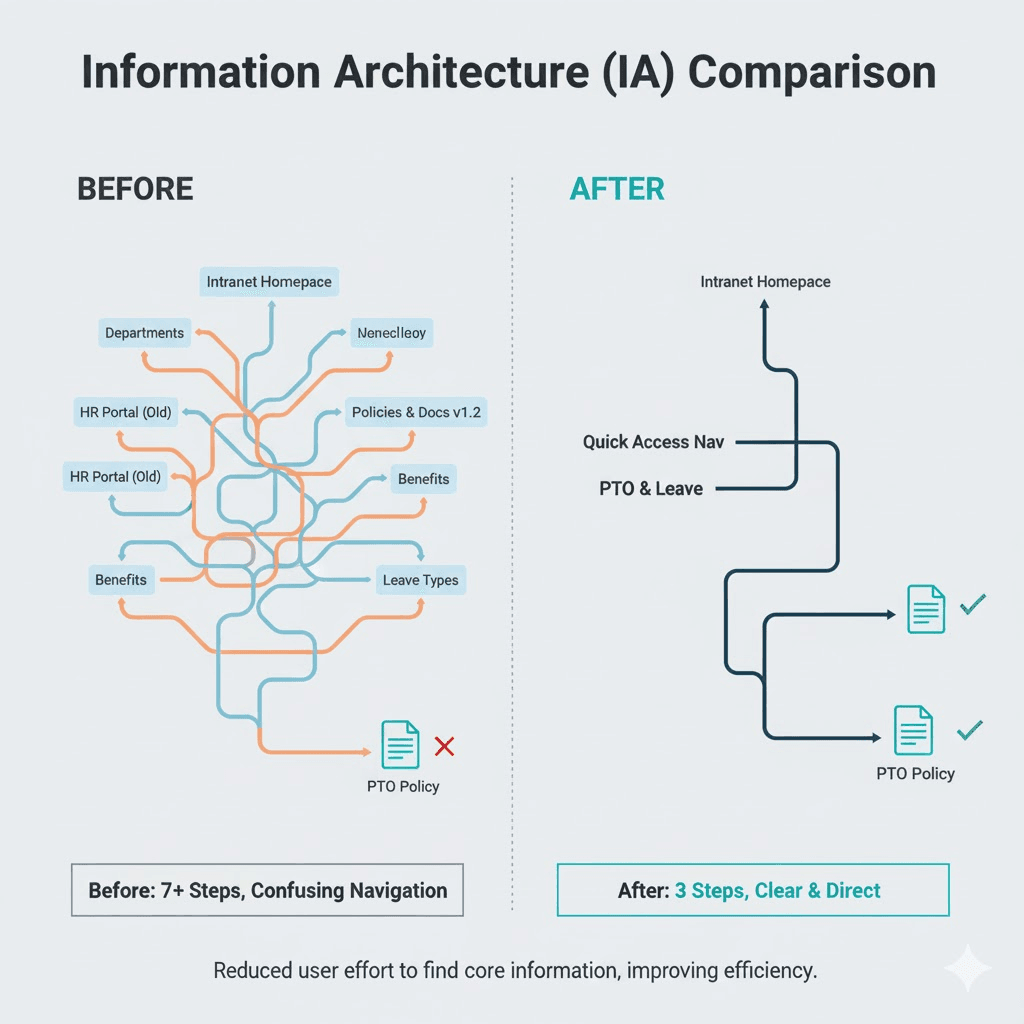
We faced two critical issues: first, it was a knowledge graveyard, making critical documents, company policies, and key organisational updates nearly impossible to find. Second, its static, one-size-fits-all structure poorly served our increasingly dynamic and global workforce.
My strategic framing of the challenge elevated it from a mere "tool redesign" to a matter of core business capability and employee experience (EX). vision was ambitious yet clear: design a unified, human-centered intranet that not only streamlined access to information but strengthened the connective tissue of Workday’s customer experience. We positioned the intranet not as an endpoint, but as a living ecosystem supporting every Success Plan engagement globally.
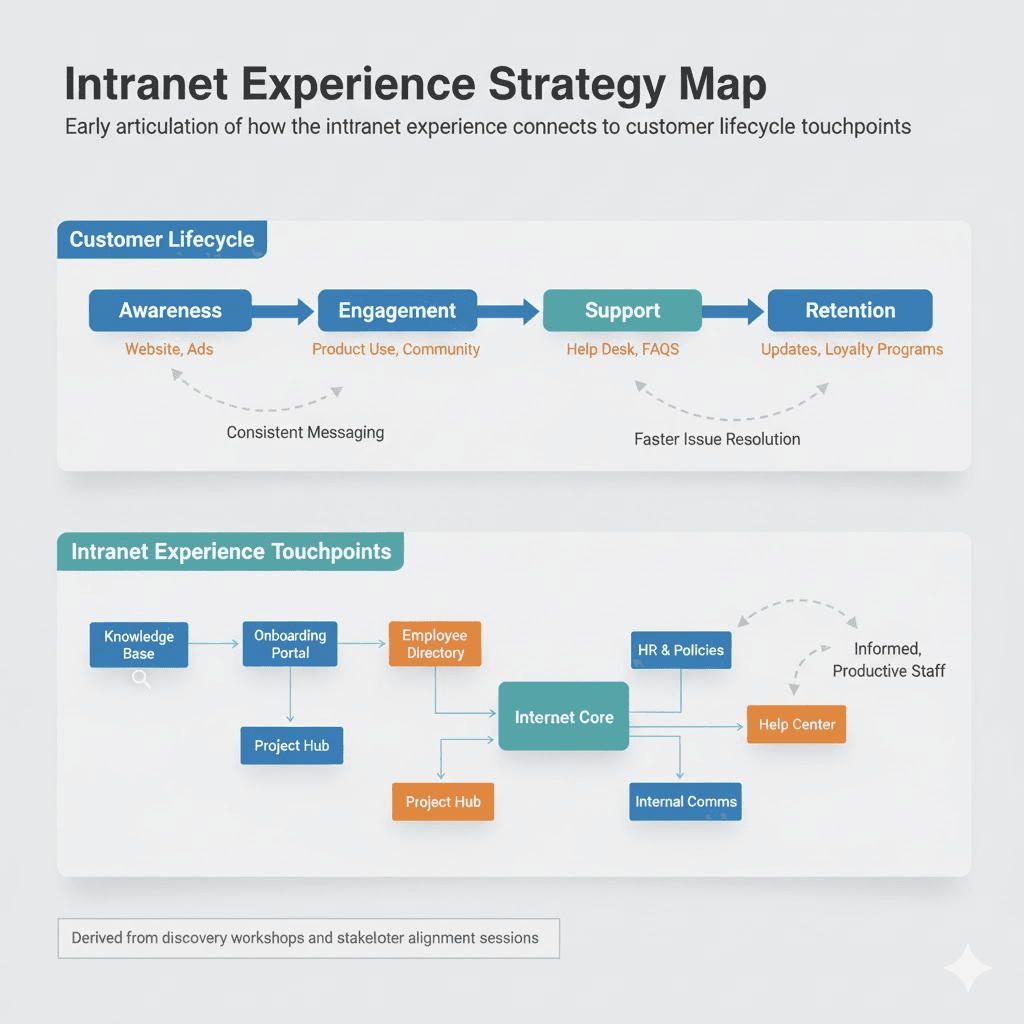
Vision & Strategy: From Repository to Digital Ecosystem
| “Empathy uncovered the friction behind efficiency.”
We began with research sprints across Customer Success, Education Services, and Product Enablement.
I led contextual interviews and journey mapping sessions that revealed one consistent theme: people spent more time *searching* for information than acting on it.
We found that we needed an intranet that acted as a curated, personalized feed and a dynamic work hub. This required a strategic, leadership-driven approach:
Strategic Framing and Trade-Offs
Defining the Business Rationale: I worked closely with IT and HR leadership to establish clear Key Performance Indicators (KPIs) focused on search success rates, document retrieval time, and overall employee satisfaction (eNPS). This ensured that design outcomes were directly mapped to the company’s strategic agenda.
Scoping the Technical Trade-Offs: The legacy platform couldn't support the vision. I led a deep dive with Engineering Leadership to evaluate the trade-offs between rebuilding the infrastructure versus adopting a modern, off-the-shelf solution. We ultimately chose a hybrid approach: building a modern, flexible front-end layer integrated via API with existing, secure back-end data sources, mitigating the risk of a full-scale migration.
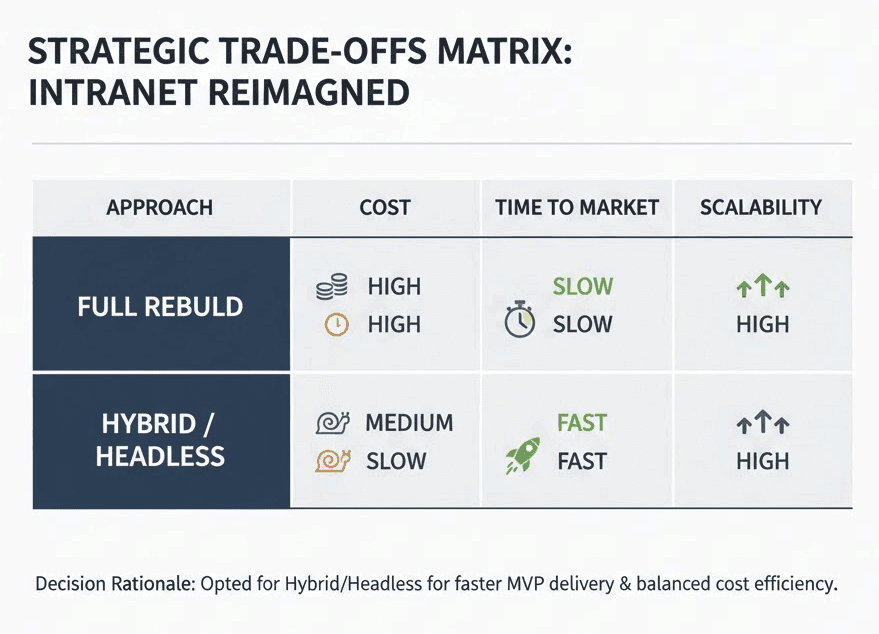
Through synthesis workshops, we distilled our findings into four opportunity areas: Findability, Consistency, Governance, and Insight. This reframed our goal from content reorganisation to experience orchestration. We found that our key opportunities were to…
Establish a shared taxonomy and content governance model
Introduce intelligent search and personalization
Design for modular scalability and future integration
Embed metrics and feedback loops from day one
Experience Architecture – Designing the System
| “We designed a system, not a site.”
In this phase, I led the creation of the Experience Architecture—an integrated model that balanced information hierarchy, governance, and design scalability.
Partnering with engineering and content strategy, we built a componentised framework within Workday’s design system.
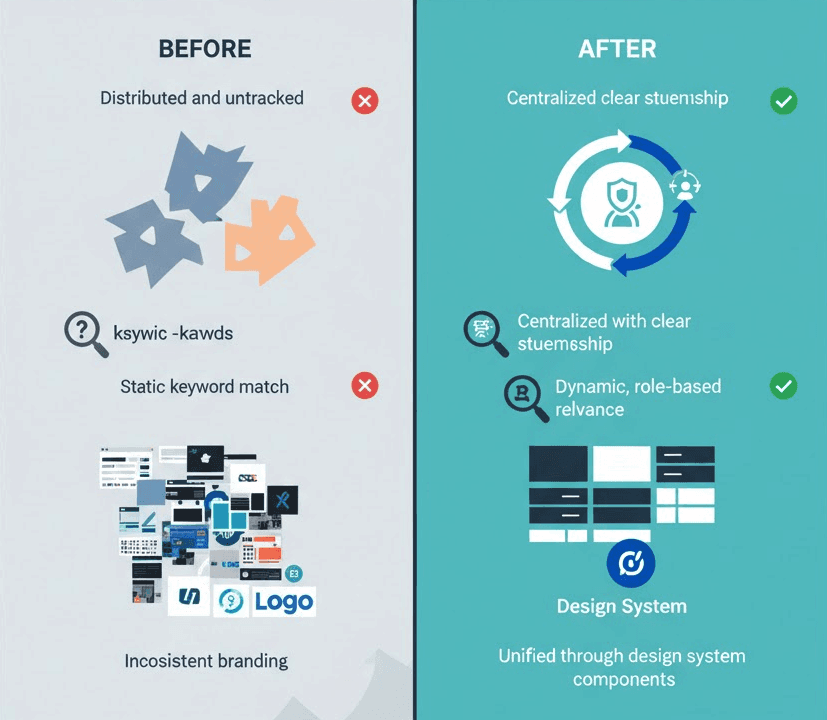
| “Design decisions came with data—making trade-offs transparent and collaborative.”
From Prototype to Platform
| “Every prototype was a negotiation between speed and depth.”
Guided by our Experience Architecture, I led co-design sessions with product and content stakeholders. Each sprint focused on validating hypotheses around navigation, personalization, and contextual guidance. Rapid prototyping allowed us to integrate feedback within days, not weeks. Our process was…
Hypothesise: Frame measurable outcomes tied to user tasks.
Prototype: Build mid-fidelity prototypes in Figma; test weekly with end users.
Measure: Refine based on task success rate and confidence scores.
Implementation & Adoption – Scaling Change
| “DesignOps turned design intent into institutional practice.”
To operationalise the design, I collaborated with PMO and Operations to establish an Experience Guild — a cross-functional governance forum ensuring standards, feedback loops, and continuous improvement.
Initiatives
Trained 120+ content owners across 7 global regions
Embedded design reviews in release cadence
Established bi-weekly Experience Guild sync for feedback and prioritization
Outcomes & Impact – From Design to Measurable Value
| “A design system that delivered measurable business impact.”
The redesigned intranet reduced cognitive load and drastically improved findability. Beyond metrics, it reshaped how teams collaborated—Design, Engineering, and Operations now worked from a shared scorecard and vocabulary.
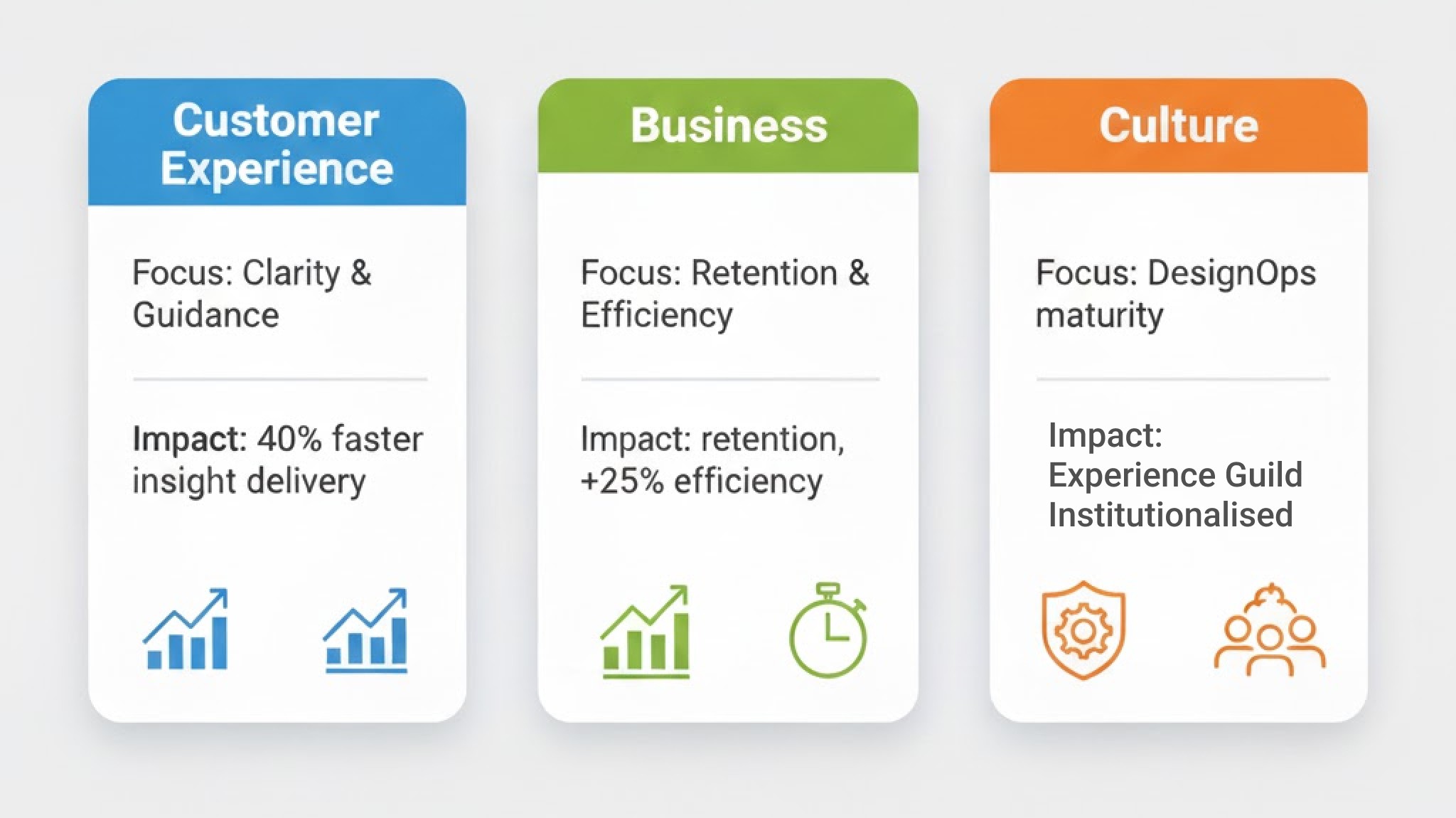
Key Metrics
Customer Retention: +8%
Operational Efficiency: +25%
Perceived Value Increase: 2.3×
Reflection & Forward View – Leading Through Design
| “Leadership in design means designing the conditions for others to succeed.”
This project reaffirmed that systemic change requires as much empathy for the organisation as for the user.
By designing frameworks, not just interfaces, we made collaboration the product. Our success wasn’t just a new intranet—it was a new way of working.
The next horizon would focus on automation and insight: leveraging analytics to proactively surface guidance within the intranet itself. As Workday evolves, our design system and governance model provide a scalable foundation for future innovation.
| “Design as a system of partnership—not production.”
Other Projects...